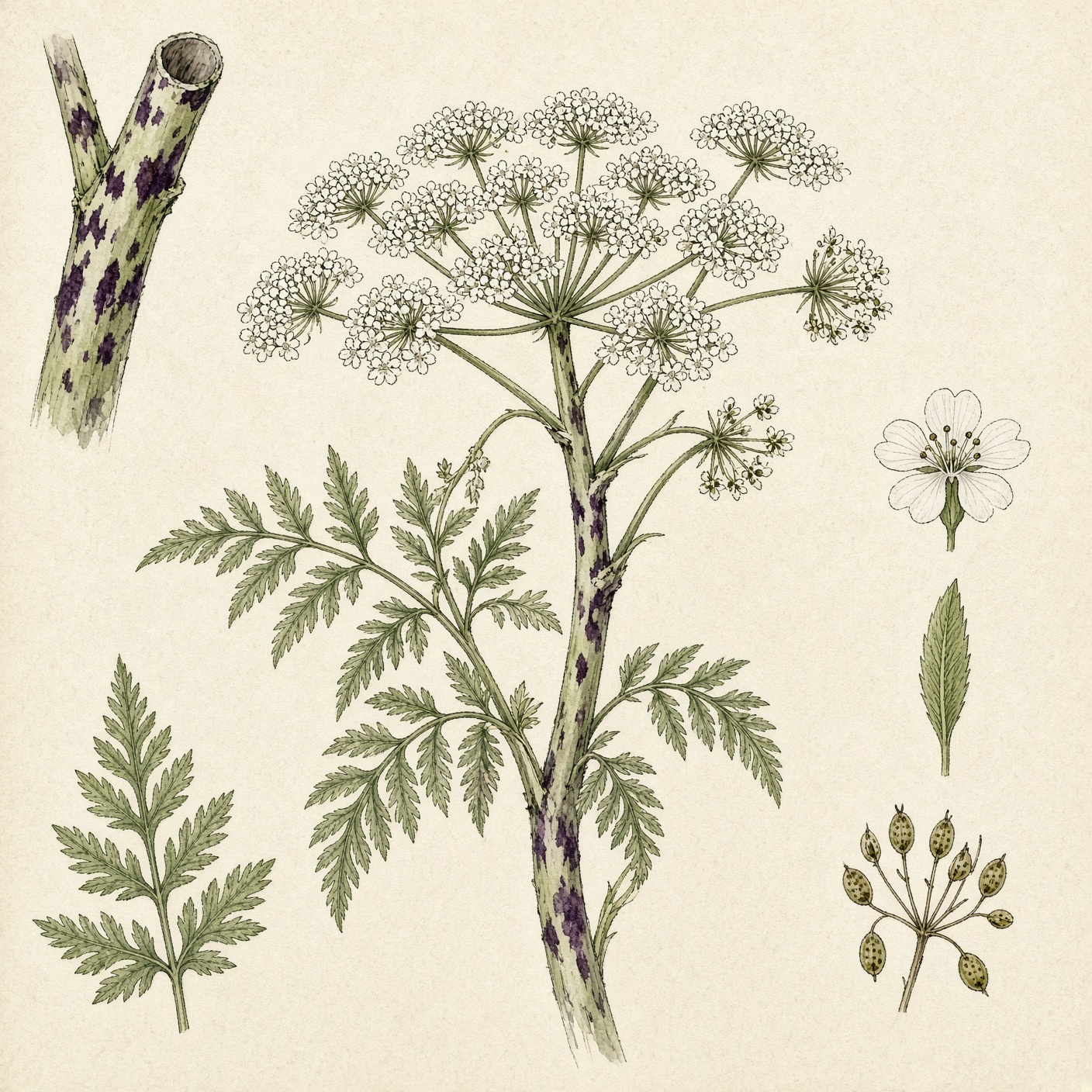
Poison hemlock
Conium maculatum
Purple-splotched hollow stems, lacy leaves, white umbels. Deadly. Do not touch your mouth after handling.
- Marks
- Purple stem blotches; hairless; musty smell; white umbels
- Size
- 4–10 ft
- Habitat
- Ditch banks, old pastures, roadsides, creek edges throughout Dearborn County.
- Season
- Rosettes overwinter; blooms May–July.
- Frequency
- common
A biennial that can top 8 ft. Stems are smooth, hollow, and blotched with purple. Leaves are finely divided, ferny, with a musty mouse-urine smell when crushed. Flowers are tiny white umbels like Queen Anne’s lace, but the plant has no hairy stem and no single dark floret.
If this is the one
All parts are poisonous. Alkaloids paralyze the breathing muscles. Never use as a wild carrot. Call 911 and Poison Control 1-800-222-1222 if ingested.
If eaten: do not wait for symptoms. Call 911. Save a sample of the plant. Do not induce vomiting unless a clinician tells you to.
Lookalikes
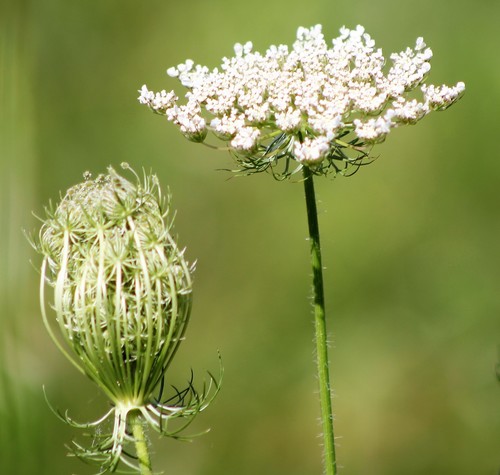
Queen Anne’s lace
Daucus carota
Wild carrot. Hairy stem, one dark floret in the white lace, carrot-scented taproot.
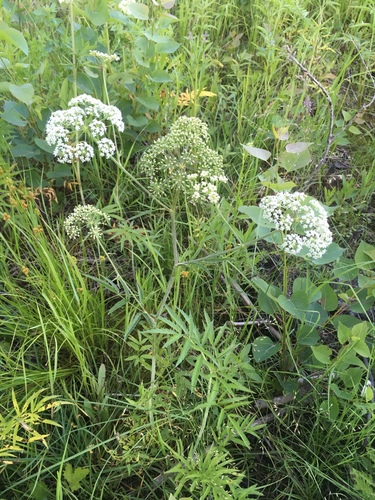
Water hemlock
Cicuta maculata
The most violently toxic plant in Indiana wetlands. Chambered root, purple-streaked stems.